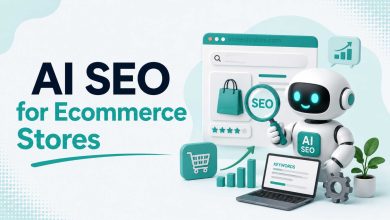
How to Use AI in Ecommerce Business ? : Comprehensive Guide 2026
AI in Ecommerce Business : The ecommerce industry in 2026 is growing faster than ever before, and customer expectations are changing rapidly. Online shoppers now expect personalized experiences, instant support, accurate product suggestions, smooth checkout systems, faster delivery, and better after-sales service. Traditional ecommerce methods are no longer enough to stay competitive. This is where Artificial Intelligence becomes one of the most powerful tools for modern online businesses. AI in ecommerce is no longer a future concept. It is now a real business advantage that helps stores increase sales, improve customer experience, reduce costs, and scale operations with smarter decisions.
Table of Contents
Artificial Intelligence in ecommerce means using advanced technologies such as machine learning, predictive analytics, natural language processing, automation systems, and generative AI to improve how online stores operate. AI can study customer behavior, forecast buying trends, automate repetitive tasks, recommend products, detect fraud, optimize pricing, and improve marketing performance. In 2026, businesses that use AI effectively are more likely to grow faster and outperform competitors.
Why AI Matters for Ecommerce in 2026

The biggest reason AI matters is customer behavior. Today’s shoppers want stores to understand their needs. They do not want to waste time searching through irrelevant products or waiting hours for support replies. They expect brands to deliver relevant experiences instantly. AI helps ecommerce businesses meet these expectations at scale.
Another major reason is competition. Thousands of ecommerce stores sell similar products. Competing only on price is difficult and risky. AI allows businesses to compete through better customer experience, smarter operations, and more efficient marketing.
Also Read : B2C Ecommerce Growth Strategies : Comprehensive Guide 2026
AI also helps reduce costs. Ecommerce businesses often spend large amounts on customer service, advertising, content creation, inventory mistakes, and fraud losses. AI reduces waste by automating tasks and improving decision-making.
Key Benefits of AI in Ecommerce Business
Better Customer Experience
AI creates personalized shopping journeys. Instead of showing the same products to every visitor, AI can display items based on browsing history, previous purchases, location, preferences, and behavior.
Higher Conversion Rates
When customers see products they actually want, they are more likely to buy. AI-powered recommendations often increase conversions and average order value.
Lower Operational Costs
Many repetitive tasks can be automated using AI, including answering common questions, generating product content, sorting tickets, and sending follow-up emails.
Smarter Marketing
AI improves ad targeting, customer segmentation, campaign performance, and content creation. This helps businesses spend marketing budgets more efficiently.
Reduced Fraud
AI systems can detect suspicious activity in real time and help prevent fake orders, chargebacks, and payment fraud.
How to Use AI in Ecommerce Business
AI Product Recommendations
One of the most profitable uses of AI is product recommendation systems. AI analyzes customer actions such as Taps, views, purchases, and searches. Based on this data, it suggests relevant products.
Examples include:
- Frequently bought together
- Customers also bought
- Similar products
- Recommended for you
- Recently viewed items
This strategy increases order value and improves user engagement.
AI Chatbots and Customer Support
Customer support can be expensive and time-consuming. AI chatbots provide instant responses 24/7 and handle common questions without human intervention.
Examples:
- Where is my order?
- What is your return policy?
- Do you have this in another size?
- Which product is best for me?
- How do I track my package?
Modern chatbots can also transfer complex issues to human support teams when needed.
AI Search and Product Discovery
Many ecommerce websites lose sales because customers cannot find products quickly. AI-powered search understands customer intent rather than relying only on exact keywords.
For example:
- Black shoes under ₹3000
- Gift for mother
- Wireless headphones with long battery
AI search can also understand spelling mistakes, voice queries, and natural language searches.
AI Personalization
Personalization is one of the strongest ecommerce growth strategies in 2026. AI can personalize nearly every part of the customer journey.
Examples:
- Homepage banners
- Product collections
- Search results
- Discounts
- Email campaigns
- Push notifications
- Recommended products
The more relevant the shopping experience feels, the higher the chances of conversion.
AI Content Creation for Ecommerce
Creating content for hundreds of products takes time. Ecommerce stores need product descriptions, titles, SEO content, blogs, ads, and social media posts. Generative AI makes this process faster and more scalable.
Use AI for:
- Product titles
- Product descriptions
- Meta titles
- Meta descriptions
- Category page content
- Blog articles
- Ad copy
- Email subject lines
- Social captions
However, AI-generated content should always be reviewed and edited to maintain quality and brand voice.
AI for Ecommerce SEO
Organic traffic remains valuable for ecommerce businesses. AI can support SEO strategies by helping with keyword research, content planning, competitor analysis, and on-page optimization.
Use AI for:
- Keyword ideas
- Product page SEO
- Category page optimization
- Blog topic generation
- Internal linking suggestions
- Content audits
- Search intent analysis
This can help stores attract more free traffic from search engines.
AI Inventory Management
Inventory mistakes can hurt profits. Too much stock ties up money, while too little stock causes missed sales. AI helps forecast demand using sales history, seasonal trends, promotions, and customer behavior.
Benefits include:
- Fewer stockouts
- Less dead inventory
- Better purchasing decisions
- Improved warehouse planning
- Smarter restocking schedules
AI Dynamic Pricing
Pricing strongly affects conversions and profits. AI can analyze demand, competitor prices, stock levels, and customer behavior to suggest better pricing strategies.
Examples:
- Increase prices during high demand
- Discount slow-moving products
- Offer personalized promotions
- Adjust prices during festive seasons
Dynamic pricing helps maximize revenue while staying competitive.
AI Email Marketing
Email marketing still delivers strong returns when used correctly. AI can improve email campaigns by deciding the best timing, subject lines, and product suggestions.
Use AI for:
- Cart recovery emails
- Welcome sequences
- Win-back campaigns
- Product recommendations
- Customer segmentation
- Best send time optimization
This increases open rates, Taps rates, and repeat purchases.
AI Advertising Optimization
Paid advertising can become expensive quickly. AI helps optimize campaigns by analyzing audience behavior, ad creatives, keywords, and conversions.
Use AI in:
- G Ads
- Meta Ads
- Shopping campaigns
- Retargeting campaigns
- Audience targeting
- Budget allocation
This helps businesses achieve better return on ad spend.
AI Fraud Detection
Fraud is a serious problem in ecommerce. Fake orders, stolen cards, refund abuse, and bot attacks can reduce profits. AI systems identify suspicious behavior instantly.
Examples:
- Multiple failed payments
- Unusual order patterns
- High-risk locations
- Device mismatches
- Fake account behavior
This protects revenue and reduces manual review work.
AI Logistics and Delivery Optimization
Fast delivery is important for customer satisfaction. AI helps improve logistics by optimizing routes, warehouse allocation, shipping estimates, and delivery planning.
Benefits:
- Faster delivery
- Lower shipping costs
- Better delivery accuracy
- Higher customer trust
AI Customer Retention
Acquiring new customers is expensive. Retaining existing customers is often more profitable. AI can identify customers likely to stop buying and trigger retention campaigns.
Examples:
- Loyalty rewards
- Personalized discounts
- Reorder reminders
- Subscription offers
- Special offers for repeat buyers
This increases customer lifetime value.
Buy Now : Ecommerce Website
AI Visual Search and Voice Commerce
Customers are increasingly using images and voice to shop online. AI enables both features.
Examples:
- Upload an image to find similar products
- Voice search for products
- Hands-free shopping through smart devices
This creates a faster and more convenient shopping experience.
How Small Ecommerce Businesses Can Start with AI
Many small business owners think AI is only for big brands. That is no longer true. Affordable tools now make AI accessible to businesses of all sizes.
Step 1: Identify One Problem
Choose one area where AI can create the biggest impact:
- Low conversions
- Poor support
- Weak traffic
- High ad costs
- Stock issues
- Low repeat purchases
Step 2: Choose the Right Tool
Select AI tools that integrate with your ecommerce platform such as Shopify, WooCommerce, Magento, or custom websites.
Step 3: Start Small
Launch one simple AI project such as:
- AI chatbot
- Product recommendations
- SEO content generation
- Email automation
Step 4: Measure Results
Track important metrics:
- Conversion rate
- Average order value
- Revenue
- Support cost
- Repeat customer rate
- Ad performance
- Cart abandonment rate
Step 5: Scale What Works
Once results are positive, expand AI into more areas of your business.
Common Mistakes to Avoid
Using Too Many Tools at Once
Start simple. Too many systems can create confusion and technical issues.
Ignoring Data Quality
AI performs best with clean and accurate data.
No Human Review
AI should support business decisions, not replace human judgment entirely.
Generic Content
Always edit AI-generated content to match your brand tone and audience.
Ignoring Privacy
Respect customer data privacy and maintain secure systems.
Best AI Use Cases by Business Size
Beginners
- AI product descriptions
- Basic chatbot
- Email automation
- SEO content generation
Growing Stores
- Product recommendations
- Ad optimization
- Customer segmentation
- Demand forecasting
Large Brands
- Dynamic pricing
- Advanced personalization
- Fraud detection
- Supply chain automation
- Omnichannel AI systems
Future of AI in Ecommerce 2026 and Beyond

The future of ecommerce AI is moving beyond simple automation. AI systems are becoming more intelligent and capable of managing complex tasks such as campaign optimization, stock planning, support workflows, and personalized shopping journeys.
Buy Now : Ecommerce Website
In the coming years, successful ecommerce brands will combine human creativity with AI efficiency. Businesses that build strong systems, clean data, and customer-focused strategies will gain the biggest advantage.
Conclusion
Artificial Intelligence is transforming ecommerce into a smarter, faster, and more profitable business model. Whether you run a small online store or a large ecommerce brand, AI can help you personalize customer experiences, increase conversions, improve SEO, optimize pricing, reduce fraud, manage inventory, and automate marketing. The smartest strategy in 2026 is not replacing humans with AI. It is using AI as a powerful assistant to make better decisions and create better customer experiences. Businesses that start using AI today will be in a stronger position to grow, compete, and succeed in the future.