Malayali vs Gujaratis : Stock Market Behaviour 2026 – Comprehensive Guide
Stock Market Behaviour : India’s investment culture is changing rapidly in 2026. Stock markets, SIPs, mutual funds, IPO investing, gold accumulation, and real estate ownership are becoming everyday financial discussions across households. Yet, one fascinating behavioural finance observation continues to stand out strongly in India: Gujaratis historically show a much higher participation in stock markets and business investing compared to Malayalis, who traditionally prefer safer and tangible assets such as gold, land, fixed deposits, and real estate. This difference is not simply about intelligence, awareness, or financial capability. It is deeply connected with behavioural finance, cultural history, family mindset, economic structure, social conditioning, and risk perception.
The comparison between Malayalis and Gujaratis in stock market behaviour has become one of the most discussed finance topics in India because it reveals how psychology influences wealth creation. The uploaded presentation clearly highlights how Kerala households and Gujarat households think differently when it comes to investing, wealth preservation, risk-taking, and long-term capital allocation. Understanding these behavioural patterns can help investors make smarter decisions and build balanced portfolios in 2026 and beyond.
Understanding Behavioural Finance in India

Behavioural finance studies how emotions, biases, habits, social conditioning, and psychological tendencies influence investment decisions. Traditional finance assumes that investors are rational, but real-world investing proves otherwise. People often buy assets emotionally, avoid risks irrationally, follow social trends, or remain attached to familiar investments even when better opportunities exist.
The presentation introduces the concept beautifully by comparing Kerala’s traditional preference for gold and land against Gujarat’s preference for stocks, business equity, and IPOs. Kerala households generally focus on physical assets that provide emotional security, while Gujarat households often focus on business growth, equity ownership, and wealth compounding through capital markets.
This contrast is not about one community being superior to another. Instead, it demonstrates how culture and environment shape financial behaviour.
Why Gujaratis Invest More in Stocks
One of the strongest observations from the presentation is that Gujarat households traditionally allocate more money toward stocks, IPOs, and business ventures. Several historical and structural reasons contribute to this.
Business Heritage and Entrepreneurial Culture
Gujarat has a centuries-old business culture. Trading communities, merchant families, and entrepreneurial ecosystems are deeply rooted in the state’s economic identity. Business discussions happen regularly within families, and children often grow up learning about profits, losses, market cycles, negotiations, and risk-taking from a young age.
This creates familiarity with uncertainty. Stock market volatility does not appear frightening because business families already understand fluctuations as part of wealth creation.
Also Read : Best Ecommerce Business Models
The presentation highlights Gujarat’s “trader-business community heritage” as one of the core reasons behind strong equity participation. Gujaratis often view stock markets as an extension of business ownership rather than gambling.
Proximity to Financial Ecosystems
Historically, Gujarat benefited from close financial ties with Mumbai and Ahmedabad, both major financial hubs connected to stock exchanges and trading communities. The presentation mentions the “BSE proximity advantage” which helped generations become more aware of equity investing and capital markets.
Being close to financial centres increases exposure to brokers, IPO discussions, investment opportunities, and financial literacy.
Family Conversations About Wealth
In many Gujarati households, conversations about stocks, IPOs, trading, and businesses are common dinner-table discussions. This creates early financial education informally.
When investing becomes normalized socially, participation naturally increases. Children observe elders discussing shares and investments confidently, reducing fear and hesitation.
Higher Risk Tolerance
Gujarat’s economy has historically rewarded entrepreneurship and calculated risk-taking. As a result, Gujaratis often display higher tolerance toward short-term market fluctuations in pursuit of long-term gains.
This mindset aligns perfectly with equity investing, where patience and risk tolerance are critical.
Why Malayalis Traditionally Prefer Gold and Real Estate
Kerala has one of India’s most financially disciplined populations, but the preferred investment vehicles differ significantly from Gujarat.
The presentation identifies gold, land, and savings-oriented assets as Kerala’s dominant investment choices.
Emotional Security of Physical Assets
Gold occupies a special cultural and emotional place in Kerala. Gold jewellery is associated with weddings, social status, family security, emergency savings, and generational wealth preservation.
Unlike stocks, gold is visible and tangible. Many Malayalis feel psychologically safer holding physical assets they can touch and store.
Land ownership also carries strong emotional value because property is viewed as permanent security.
Salaried Economy Mindset
The presentation mentions Kerala’s “salary-first economy” dominated by government jobs, Gulf employment, and stable income structures. Salaried individuals often prioritize wealth protection over aggressive wealth growth.
This naturally encourages conservative investments such as:
- Fixed deposits
- Gold accumulation
- Real estate
- Savings schemes
- Insurance products
Such investors typically avoid high-volatility assets.
Gulf Remittance Culture
Kerala’s economy has been heavily influenced by Gulf remittances for decades. Families receiving foreign income often invested heavily in homes, land, and jewellery instead of equity markets.
This created a real estate and gold accumulation cycle that became socially accepted and financially dominant.
Limited Equity Conversations
Unlike Gujarat’s business-oriented family culture, many Kerala households historically lacked stock market discussions. Equity investing was often seen as risky speculation rather than long-term wealth creation.
This lack of exposure delayed widespread participation in capital markets.
The Data Behind the Behaviour
The uploaded slides present interesting behavioural observations regarding investment preferences.
Gujarat’s Strong Equity Presence
The presentation highlights:
- Gujarat having over 1.05 crore demat accounts
- Strong equity delivery participation
- Large involvement in IPO investing
- Higher business equity ownership
This reflects Gujarat’s deep-rooted participation in India’s financial markets.
Kerala’s Gold Dominance
The slides also indicate:
- Kerala being among the top gold-consuming regions in India
- Strong preference for physical gold over paper gold
- Lower equity allocation in household portfolios
This supports the idea that Malayali investors prefer stable, familiar, and tangible assets.
Five Behavioural Biases Affecting Malayali Investors
One of the most important sections in the presentation explains behavioural biases that may prevent higher stock market participation among Malayalis.
1. Loss Aversion
Loss aversion is one of the most powerful concepts in behavioural finance. People emotionally feel losses more strongly than gains.
\text{Psychological Pain of Loss} \approx 2 \times \text{Pleasure of Gain}
Malayali investors often fear losing money in stocks more than they value potential long-term returns. Market crashes create emotional fear that discourages participation.
This results in excessive preference for “safe” assets.
2. Status Quo Bias
Status quo bias means people prefer maintaining existing habits rather than changing.
Families that historically invested in:
- Gold
- Fixed deposits
- Land
- Chit funds
often continue doing the same without exploring modern investment products.
Even when equity investments outperform over decades, investors may avoid change due to comfort and familiarity.
3. Herd Mentality
The presentation points out how family and community influence investment decisions.
If most relatives invest in gold and real estate, individuals are likely to follow the same path. Social validation strongly affects financial behaviour.
Similarly, in Gujarat, people often follow community participation in business and equities.
4. Recency Bias
Recency bias occurs when recent negative events influence future decisions excessively.
For example:
- Market crashes
- Scam news
- Economic downturns
can create long-lasting fear about stocks, even if markets historically recover over time.
Many conservative investors remember short-term crashes more than long-term wealth creation.
5. Anchoring Bias
Anchoring bias happens when investors remain attached to familiar reference points.
Malayalis may anchor strongly to:
- Gold prices
- Land appreciation
- Fixed deposit returns
because these assets are culturally familiar.
Stocks appear uncertain because there is less emotional familiarity.
Structural Reasons Behind the Gap

The presentation correctly emphasizes that this investment difference is not a character flaw but a structural and historical outcome.
Several macro-level reasons explain the gap.
Kerala’s Economic Structure
Kerala’s economy has historically focused more on:
- Services
- Government employment
- Overseas jobs
- Remittance income
These sectors encourage income stability rather than entrepreneurial risk-taking.
Gujarat’s Business Ecosystem
Gujarat developed around:
- Manufacturing
- Trading
- Entrepreneurship
- Industrial growth
This environment naturally encourages equity participation and business investments.
Financial Literacy Differences
Financial education exposure varies significantly across regions. Areas with stronger equity participation develop faster investment literacy.
Today, however, this gap is narrowing due to YouTube finance creators, social media, digital brokers, and SIP awareness campaigns.
Typical Household Portfolio Comparison
One of the most insightful parts of the uploaded presentation compares average portfolio structures.
Kerala Household Portfolio
Typical allocation patterns include:
- Gold and jewellery: 35–45%
- Real estate: 30–40%
- Fixed deposits and savings: 15–20%
- Stocks and mutual funds: Less than 10%
This demonstrates a heavy preference toward physical and low-risk assets.
Gujarat Household Portfolio
Typical allocation patterns include:
- Stocks and IPOs: 25–35%
- Business equity: 20–30%
- Real estate: 20–25%
- Gold and FDs: 15–20%
This shows stronger exposure to growth-oriented assets.
The difference in equity allocation significantly impacts long-term wealth compounding.
The Power of Equity Compounding
Equity investing benefits enormously from compounding over long periods.
genui{“math_block_widget_always_prefetch_v2”:{“content”:”A = P\left(1+\frac{r}{n}\right)^{nt}”}}
Where:
- (A) = future investment value
- (P) = principal investment
- (r) = annual return rate
- (n) = compounding frequency
- (t) = time
Even small SIP investments can generate substantial wealth over decades if invested consistently.
This is why younger Malayali investors are increasingly shifting toward mutual funds and equities in 2026.
Rise of SIP Culture in Kerala
The investment culture in Kerala is changing rapidly.
Today’s younger generation has access to:
- Financial YouTube channels
- Stock market apps
- Discount brokers
- Mutual fund platforms
- Online financial education
- Personal finance creators
SIP investing is growing significantly because it reduces emotional pressure and enables disciplined investing.
The presentation recommends starting with SIPs even at small amounts such as ₹500 per month.
This is extremely practical advice because consistent investing matters more than large initial capital.
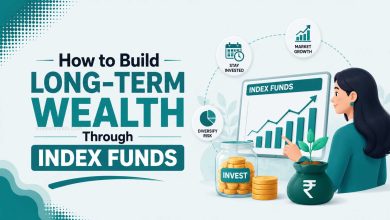
Why Index Funds Are Becoming Popular
The slides also suggest “Index Funds First.”
This is important because many new investors lose money attempting aggressive stock picking without knowledge.
Index funds offer:
- Diversification
- Lower risk
- Lower expense ratios
- Passive wealth creation
- Long-term market participation
For conservative investors transitioning from gold and FDs, index funds provide a psychologically comfortable entry point into equities.
Long-Term Investing Mindset
Another powerful insight from the presentation is the recommendation for a “10-year horizon.”
Stock markets reward patience. Short-term volatility often scares new investors, but long-term investing historically generates stronger wealth creation.
Malayali investors who traditionally avoided equities may benefit greatly by adopting long-term thinking rather than expecting instant profits.
Balanced Investing Is the Future
The presentation wisely avoids extreme conclusions. It does not say gold is bad or stocks are superior.
Instead, it promotes balance.
The suggested “70–20–10 mix” encourages diversification rather than abandoning traditional assets completely.
A balanced portfolio could include:
- Equity mutual funds
- Index funds
- Gold
- Real estate
- Emergency savings
- Fixed income assets
Diversification reduces risk while improving growth potential.
The Evolution of Financial Behaviour in 2026
India’s investment ecosystem is transforming quickly.
Several trends are reshaping investor behaviour:
Digital Investing Apps
Platforms like Zerodha, Groww, Upstox, and Angel One simplified investing dramatically. Mobile-first investing increased stock market accessibility even in smaller towns.
Financial Content Explosion
Malayalam finance creators on YouTube are educating audiences about:
- SIP investing
- Mutual funds
- Stock market basics
- Retirement planning
- Wealth building
This is reducing fear and increasing participation.
Rising Inflation Awareness
People increasingly realize that fixed deposits alone may not beat inflation over long periods.
This is pushing younger investors toward equities.
IPO Culture
India’s booming IPO market has also attracted retail investors from states traditionally less active in equities.
Are Malayalis Changing Their Investment Behaviour?
Yes, significantly.
The younger generation in Kerala is far more financially aware than previous generations.
Several positive trends are emerging:
- Increasing demat account openings
- Higher SIP registrations
- Mutual fund adoption
- Interest in ETFs and index funds
- Financial literacy growth
- Startup ecosystem awareness
However, risk management remains important.
Blind speculation and FOMO investing can be dangerous.
The ideal approach combines Kerala’s financial discipline with Gujarat’s growth-oriented mindset.
Lessons Malayalis Can Learn from Gujaratis
Malayali investors can adopt several positive financial habits:
Think Long-Term
Equity investing requires patience.
Discuss Finance Openly
Family-level financial education matters greatly.
Learn Business Thinking
Understanding businesses improves stock market confidence.
Start Small
Investing does not require huge money initially.
Focus on Asset Allocation
Balanced portfolios create stability and growth.
Lessons Gujaratis Can Learn from Malayalis
Interestingly, Gujaratis can also learn valuable lessons from Kerala’s conservative approach.
Importance of Safety Nets
Emergency savings and stable assets matter during crises.
Real Estate Stability
Physical assets provide diversification benefits.
Avoid Overleveraging
Aggressive risk-taking without discipline can create financial stress.
Emotional Financial Discipline
Kerala households often excel at saving and controlling unnecessary spending.
Future of Indian Investment Behaviour
By 2030, regional investment differences may reduce significantly because digital education is spreading rapidly.
Future Indian investors will likely combine:
- Gold ownership
- SIP investing
- Index fund exposure
- Real estate
- International diversification
- Retirement planning
Behavioural finance awareness will also improve decision-making.
Investors are slowly understanding that emotional control matters more than stock tips.
Stock Market Behaviour – Conclusion

The “Malayali vs Gujaratis: Stock Market Behaviour 2026” comparison is one of the most fascinating behavioural finance discussions in India today. It reveals how culture, family structure, economic history, and psychology shape investment behaviour.
The uploaded presentation clearly demonstrates that Kerala’s preference for gold and land originates from security-oriented financial thinking, while Gujarat’s stronger participation in stocks and business equity comes from entrepreneurial culture and higher risk tolerance.
Buy Now : Ready Made Digital Store with 100 Products
Most importantly, this difference should not be viewed as a competition between communities. Both approaches contain strengths and weaknesses. Kerala’s conservative mindset protects stability, while Gujarat’s growth-oriented mindset accelerates wealth creation through equities and entrepreneurship.
The ideal modern investor in 2026 should combine the best of both worlds:
- Kerala’s disciplined saving habits
- Gujarat’s equity participation mindset
- Long-term investing patience
- Balanced diversification
- Financial literacy
- Emotional discipline
As India’s financial ecosystem evolves, younger generations are already breaking traditional investment patterns. SIPs, index funds, ETFs, and digital investing are helping more Malayalis participate in wealth creation opportunities while still maintaining their traditional financial caution.
The future belongs not to investors who avoid risk completely, nor to those who take reckless risks, but to those who understand behavioural finance, manage emotions wisely, and build balanced long-term portfolios.
Keywords : Stock Market Behaviour – Stock Market Behaviour 2026