


Ecommerce Workflow Automation : Comprehensive Guide 2026

Ecommerce Workflow Automation :The ecommerce industry has experienced explosive growth over the past decade, creating new opportunities for businesses to reach customers worldwide. However, as online stores expand, so does the complexity of managing daily operations. Modern ecommerce businesses must handle product listings, inventory updates, order processing, payment verification, customer support, shipping coordination, marketing campaigns, returns management, accounting, supplier communication, and business analytics—all while maintaining exceptional customer experiences. Managing these tasks manually quickly becomes inefficient, expensive, and prone to human error. This is why Ecommerce Workflow Automation has become one of the most valuable business strategies in 2026.
Table of Contents
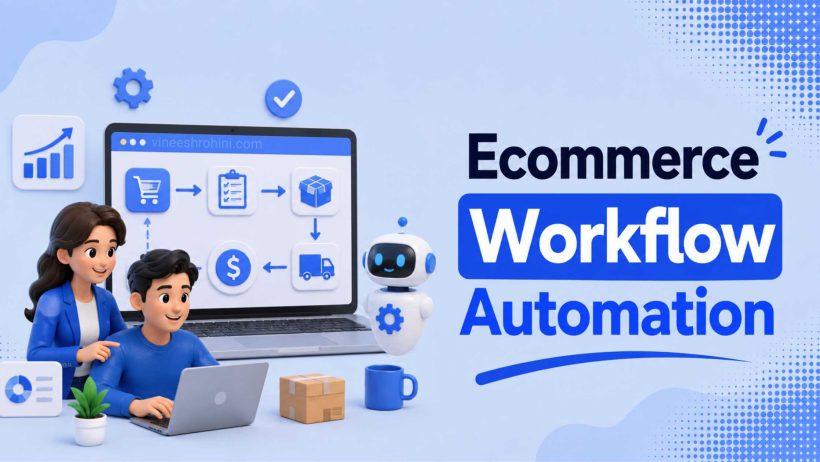
Ecommerce Workflow Automation refers to the use of software, Artificial Intelligence (AI), machine learning, and digital automation tools to perform repetitive business processes with minimal human intervention. Instead of employees manually completing every task, automated workflows intelligently move information between systems, trigger actions based on predefined conditions, and ensure that operations continue efficiently around the clock.
Automation is no longer limited to large enterprise organizations. Cloud computing, Software-as-a-Service (SaaS) platforms, AI-powered automation tools, and no-code workflow builders have made advanced automation accessible to startups, small businesses, and medium-sized ecommerce companies. Entrepreneurs can now automate everything from order confirmations and abandoned cart emails to inventory synchronization, supplier notifications, customer segmentation, fraud detection, and financial reporting without requiring extensive technical expertise.
Artificial Intelligence has significantly enhanced workflow automation by introducing intelligent decision-making capabilities. AI systems can predict customer demand, recommend inventory replenishment, personalize marketing campaigns, identify fraudulent transactions, optimize pricing, analyze customer behavior, generate product descriptions, and even respond to customer inquiries through conversational chatbots. Rather than simply following predefined rules, AI-powered automation continuously learns from business data and improves operational efficiency over time.
Customer expectations are also driving automation adoption. Modern shoppers expect instant order confirmations, real-time shipping updates, fast customer support, personalized recommendations, accurate inventory availability, and seamless shopping experiences across multiple channels. Businesses that automate customer interactions respond more quickly, reduce errors, and deliver consistently high service quality.
Workflow automation also improves employee productivity. Instead of spending hours on repetitive administrative work, teams can focus on strategic activities such as product development, customer relationship building, marketing innovation, and business expansion. Automation reduces operational costs while improving job satisfaction by eliminating routine manual tasks.
As ecommerce continues becoming more competitive, workflow automation has shifted from being a luxury to becoming a business necessity. Companies that automate intelligently operate more efficiently, respond faster to market changes, reduce operational risks, and scale their businesses without proportionally increasing labor costs.
This comprehensive guide explores every aspect of Ecommerce Workflow Automation in 2026, including Artificial Intelligence, order processing, inventory management, customer support, marketing automation, financial workflows, supplier management, implementation strategies, common mistakes, and future trends shaping intelligent ecommerce operations.
What Is Ecommerce Workflow Automation ?

Ecommerce Workflow Automation is the process of using software and Artificial Intelligence to automate repetitive business activities.
Also Read : Virtual Reality Ecommerce
Instead of relying on manual operations, automated systems complete predefined tasks automatically.
Examples include:
- Order processing
- Inventory updates
- Email notifications
- Customer support
- Shipping coordination
- Financial reporting
Automation connects different business systems into a seamless workflow.
Businesses become more efficient.
Human effort focuses on higher-value activities.
Why Workflow Automation Matters
Growing ecommerce businesses process thousands of daily activities.
Manual operations often create:
- Delays
- Human errors
- Higher labor costs
- Customer dissatisfaction
Automation improves:
- Speed
- Accuracy
- Productivity
- Customer experience
Businesses operate continuously without interruption.
Efficiency becomes a competitive advantage.
Artificial Intelligence in Workflow Automation
Artificial Intelligence extends automation beyond simple rule-based processes.
AI supports:
- Predictive analytics
- Customer segmentation
- Fraud detection
- Product recommendations
- Inventory forecasting
- Dynamic pricing
Machine Learning continuously improves workflow performance.
Businesses make smarter decisions automatically.
Technology adapts to changing business conditions.
Order Processing Automation
Order processing is one of the most important automation opportunities.
Automated workflows handle:
- Order confirmation
- Payment verification
- Inventory deduction
- Warehouse notification
- Shipping label generation
Customers receive immediate updates.
Processing becomes faster and more accurate.
Automation reduces operational bottlenecks.
Inventory Management Automation
Inventory accuracy directly influences customer satisfaction.
Automated systems monitor:
- Stock levels
- Reorder points
- Warehouse quantities
- Supplier notifications
Artificial Intelligence predicts future inventory requirements.
Businesses avoid stock shortages and overstocking.
Inventory optimization improves profitability.
Customer Support Automation
Customer expectations continue increasing.
Automation improves support through:
- AI chatbots
- Automated ticket routing
- FAQ systems
- Self-service portals
Routine questions receive immediate responses.
Support teams focus on complex issues.
Customer satisfaction improves significantly.
Marketing Automation
Marketing automation enables personalized communication.
Businesses automate:
- Welcome emails
- Cart recovery
- Product recommendations
- Promotional campaigns
- Customer re-engagement
AI personalizes content based on customer behavior.
Relevant marketing increases conversions.
Automation strengthens customer relationships.
Email Workflow Automation
Email remains one of ecommerce’s highest ROI channels.
Automated workflows include:
- Order confirmations
- Shipping updates
- Birthday offers
- Product follow-ups
- Review requests
Personalized communication improves engagement.
Customers remain informed throughout their journey.
Consistency strengthens trust.
Product Information Management
Managing product catalogs manually becomes difficult as businesses grow.
Automation updates:
- Product descriptions
- Pricing
- Inventory
- Images
- Specifications
Consistent information improves customer confidence.
Search engines benefit from accurate product data.
Catalog management becomes more efficient.
Supplier Workflow Automation
Businesses increasingly automate supplier interactions.
Examples include:
- Purchase orders
- Inventory replenishment
- Shipment notifications
- Invoice processing
Improved communication strengthens supplier relationships.
Automation reduces procurement delays.
Supply chains become more reliable.
Shipping Workflow Automation
Shipping automation includes:
- Carrier selection
- Label generation
- Tracking updates
- Customer notifications
- Delivery confirmation
Artificial Intelligence recommends optimal shipping methods.
Customers receive real-time updates.
Shipping becomes faster and more accurate.
Returns Management Automation
Returns are an essential part of ecommerce.
Automation supports:
- Return approvals
- Shipping labels
- Refund processing
- Inventory updates
Efficient return workflows improve customer satisfaction.
Businesses recover inventory more quickly.
Automation reduces administrative workload.
Financial Workflow Automation
Financial operations include repetitive administrative tasks.
Automation handles:
- Invoice generation
- Expense tracking
- Tax calculations
- Payment reconciliation
- Financial reporting
Businesses improve accounting accuracy.
Real-time financial information supports decision-making.
Automation reduces manual errors.
Fraud Detection
Artificial Intelligence continuously monitors transactions.
AI identifies:
- Suspicious purchases
- Unusual payment activity
- Account anomalies
- Risk patterns
Fraud prevention protects businesses and customers.
Machine Learning improves detection accuracy.
Security strengthens customer trust.
Data Analytics Automation
Modern ecommerce generates enormous amounts of data.
Automation collects information about:
- Sales
- Customer behavior
- Inventory
- Marketing
- Website performance
AI converts raw data into actionable insights.
Businesses identify improvement opportunities quickly.
Analytics drive strategic growth.
Benefits of Workflow Automation
Automation provides multiple advantages.
Businesses experience:
- Lower operating costs
- Improved productivity
- Greater accuracy
- Faster customer service
- Better scalability
Employees focus on strategic work.
Customers receive superior experiences.
Automation supports long-term growth.
Common Challenges
Businesses may encounter:
- Integration complexity
- Employee training
- Initial implementation costs
- Data migration
- Process redesign
Careful planning reduces implementation risks.
Continuous improvement supports successful adoption.
Technology should complement business objectives.
Common Automation Mistakes
Businesses should avoid:
- Automating inefficient processes
- Ignoring customer experience
- Weak data quality
- Excessive complexity
- Poor monitoring
Automation requires regular optimization.
Human oversight remains important.
Balance produces better outcomes.
Future Trends
Several innovations will reshape workflow automation.
Artificial Intelligence
Smarter business decisions.
Hyperautomation
End-to-end business automation.
Predictive Workflows
AI anticipates business needs.
Autonomous Commerce
Minimal human intervention.
Intelligent Process Mining
Continuous workflow improvement.
Innovation will continue transforming ecommerce operations.
Best Practices

Successful ecommerce businesses should:
- Automate repetitive tasks first.
- Leverage Artificial Intelligence.
- Integrate business systems.
- Monitor workflow performance.
- Improve customer experiences.
- Maintain accurate data.
- Continuously optimize automation.
- Train employees effectively.
- Measure business outcomes.
- Scale automation gradually.
Automation should support long-term business strategy.
Ecommerce Workflow Automation – Conclusion

Ecommerce Workflow Automation has become one of the most important operational strategies for businesses competing in the digital marketplace of 2026. As ecommerce operations grow increasingly complex, automation enables organizations to manage orders, inventory, customer service, marketing, finance, logistics, and supplier relationships with greater speed, accuracy, and efficiency than traditional manual processes.
Buy Now : Ready Made Digital Store with 100 Products
Artificial Intelligence has significantly expanded the capabilities of workflow automation by introducing predictive analytics, intelligent decision-making, personalized customer experiences, fraud detection, inventory forecasting, and adaptive business optimization. AI transforms automation from simple task execution into continuous business improvement driven by data and machine learning.
Successful workflow automation extends across every department within an ecommerce organization. Automated order processing, inventory synchronization, marketing campaigns, shipping notifications, financial reporting, customer support, and supplier communications create seamless operations that improve both employee productivity and customer satisfaction. Businesses become more scalable while reducing operational costs and minimizing human error.
Importantly, automation should never eliminate the human element of ecommerce. Instead, it should free employees from repetitive administrative work, allowing them to focus on innovation, customer relationships, strategic planning, and business development. The most successful ecommerce companies combine intelligent automation with human expertise to deliver exceptional customer experiences.
Looking ahead, technologies such as hyperautomation, autonomous commerce, predictive workflows, intelligent robotics, process mining, and advanced Artificial Intelligence will continue redefining ecommerce operations. Businesses that embrace these innovations early will gain substantial competitive advantages through increased agility, operational excellence, and sustainable growth.
Ultimately, Ecommerce Workflow Automation is not simply about doing tasks faster—it is about building an intelligent business capable of adapting, scaling, and thriving in an increasingly competitive digital economy. Companies that invest in automation today will be better prepared to serve customers, improve profitability, and lead the future of ecommerce throughout 2026 and beyond.