


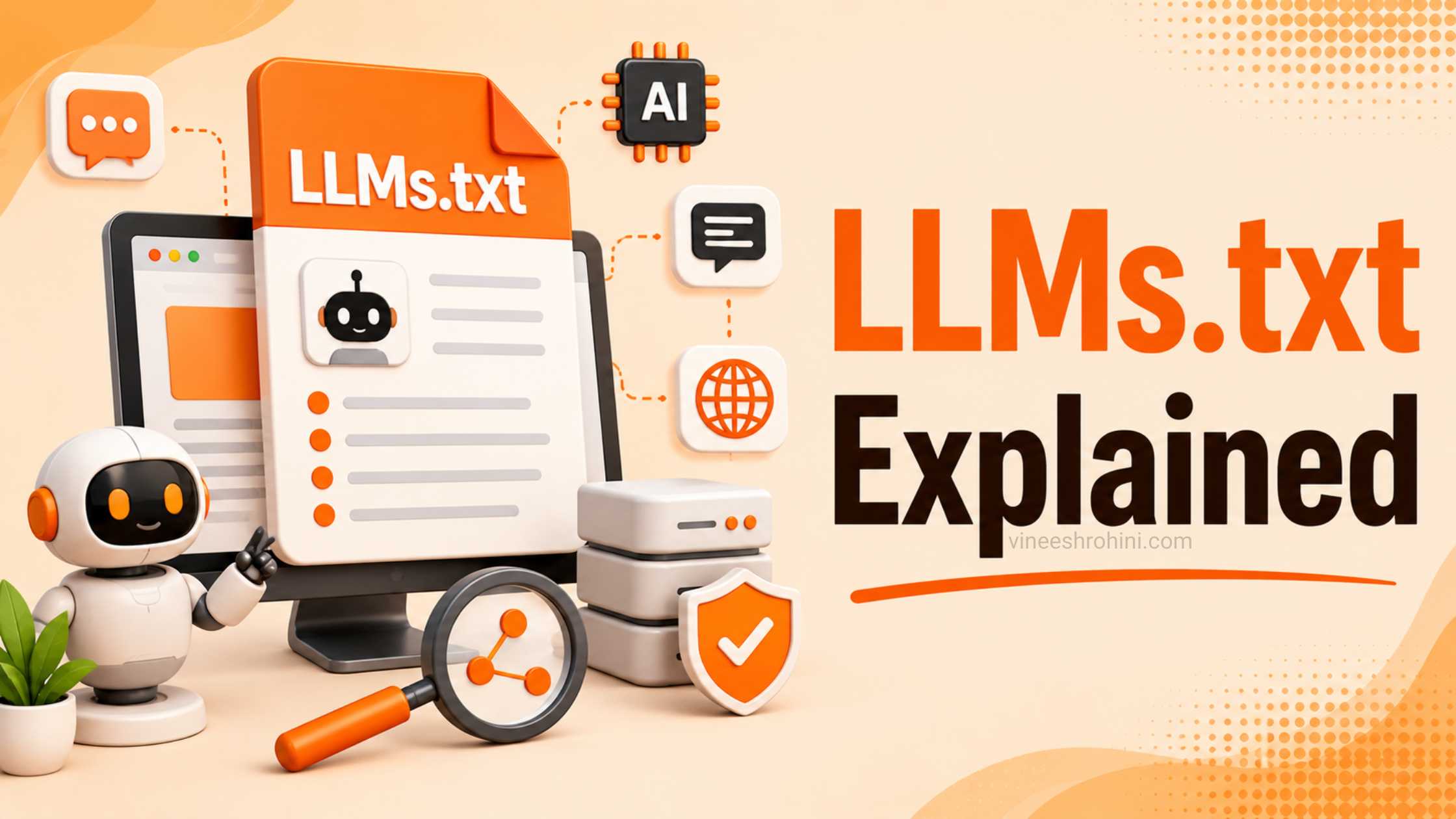
LLMs.txt Explained 2026 : A Comprehensive Guide for Website Owners and Digital Marketers

LLMs.txt : The way people discover and consume information on the internet is changing faster than ever. For more than two decades, websites were built primarily for human readers and search engine crawlers. Content was written, indexed, ranked, and clicked. Today, that model is being disrupted by Large Language Models (LLMs) that can read, summarize, and answer questions directly—often without sending users to the original source.
Table of Contents
As AI-driven answers become common across search engines, chat assistants, browsers, and operating systems, website owners are beginning to ask a critical question:
How do AI models use my content, and do I have any control over it?
This is where LLMs.txt enters the conversation.
LLMs.txt is an emerging concept designed to help website owners express preferences about how AI systems interact with their content. While it is not yet a formal or universally enforced standard, it represents an important shift toward AI-aware content governance.
This in-depth, professional guide explains what LLMs.txt is, why it exists, how it works, who should consider using it, its limitations, and its role in the future of digital marketing and SEO.
Understanding the Context: Why LLMs.txt Even Exists

To understand LLMs.txt, we first need to understand how the web itself is evolving.
For years, the dominant discovery model was:
Search → Click → Read → Convert
Today, that model is increasingly becoming:
Ask → AI Answer → Optional Source
Large Language Models can:
- Read massive amounts of public content
- Summarize multiple sources instantly
- Provide direct answers without requiring clicks
- Rewrite or paraphrase information in new contexts
Also Read : Online Business SEO Mistakes : Comprehensive Guide 2026
This shift is powerful for users, but it creates challenges for content creators and businesses:
- Reduced website traffic due to zero-click answers
- Loss of attribution or brand visibility
- Content being summarized without context
- Intellectual property and fairness concerns
LLMs.txt exists as a response to this new reality.
What Is LLMs.txt?
LLMs.txt is a proposed, human-readable text file that website owners can place on their domain to communicate preferences about how Large Language Models may access, interpret, summarize, or reuse their content.
Conceptually, it is similar to robots.txt—but with a different purpose.
- Robots.txt communicates crawling and indexing rules to search engines
- LLMs.txt communicates content usage preferences to AI models
LLMs.txt does not block access technically. Instead, it acts as a policy signal, expressing intent and expectations.
The file is typically placed at:
https://yourwebsite.com/llms.txt
How LLMs.txt Differs from Robots.txt
Although the naming is similar, the scope and intent are very different.
Robots.txt
- Designed for search engine crawlers
- Controls what can be crawled or indexed
- Widely respected and standardized
- Directly impacts SEO visibility
LLMs.txt
- Designed for AI language models
- Communicates how content may be used or summarized
- Not yet standardized or enforced
- Does not directly impact rankings
Robots.txt controls access.
LLMs.txt expresses usage intent.
What LLMs.txt Typically Contains
There is no official universal format yet, but most LLMs.txt files include guidance on how AI models should interact with the site’s content.
Common elements include statements about:
- Whether AI models may read the content
- Whether content may be summarized
- Whether attribution is required
- Whether content may be used for training
- Whether certain sections are restricted
The tone is usually descriptive rather than technical, because LLMs.txt is designed to be interpreted by policy-aware AI systems, not just crawlers.
Why Website Owners Are Paying Attention to LLMs.txt

As AI-generated answers become more common, website owners are realizing that visibility without control can be risky.
It is gaining attention because it helps:
- Clarify content ownership expectations
- Encourage responsible AI usage
- Support attribution and transparency
- Protect brand messaging and accuracy
- Prepare websites for AI-first discovery models
Even though it is not enforceable today, it reflects a growing demand for publisher-AI alignment.
Who Should Consider Using LLMs.txt
Not every website needs It immediately. Its value depends on the nature of the content and business goals.
Content Publishers and Blogs
Websites that invest heavily in original articles, research, or long-form educational content may want to define how AI systems reuse or summarize that work.
News and Media Websites
News publishers are particularly sensitive to AI summaries that replace direct readership and advertising revenue.
Educational Platforms
Courses, tutorials, and structured learning materials often need clear usage boundaries.
SaaS and Documentation Sites
Technical documentation is frequently reused in AI answers, sometimes without context or version control.
Digital Marketing and Strategy Websites
Marketing blogs, frameworks, and guides are commonly summarized by AI tools. Maintaining attribution and accuracy is crucial for brand authority.
Buy Now : Ecommerce Website
Do You Actually Need LLMs.txt?
The honest answer is: not everyone needs it right now—but many should think about it.
You May Not Need LLMs.txt If:
- Your website is small or experimental
- You actively welcome unrestricted AI summarization
- Traffic is not a primary concern
- Attribution is not important to your strategy
You Should Consider LLMs.txt If:
- Your content is proprietary or high-value
- You rely on authority and thought leadership
- You want credit when AI references your work
- You are concerned about misrepresentation
- You want to future-proof your website
It is less about immediate control and more about strategic preparedness.
LLMs.txt and SEO: Is There Any Connection?
At present, It does not directly affect SEO rankings.
However, it is closely related to the future of search.
AI-powered search experiences increasingly:
- Summarize content directly in results
- Reduce the need for users to click websites
- Reference sources selectively
In this environment, SEO is expanding beyond rankings into:
- Brand citations in AI answers
- Authority recognition by AI systems
- Trust and attribution signals
It may eventually become part of a broader AI-era SEO strategy, even if it does not influence rankings today.
The Limitations of LLMs.txt
It is important to understand what LLMs.txt cannot do.
- It cannot technically block AI models
- It is not legally binding
- Not all AI systems read or respect it
- There is no enforcement mechanism
- There is no official global standard
It is a signal, not a safeguard.
Think of it as a public statement of intent rather than a technical gatekeeper.
Why LLMs.txt Still Matters Despite Its Limitations
Even without enforcement, It has strategic value.
- It documents your position on AI usage
- It demonstrates awareness of AI governance
- It prepares your site for future standards
- It signals professionalism and transparency
- It aligns your brand with responsible AI practices
Just as robots.txt started as a voluntary convention, AI governance standards will likely evolve in stages.
LLMs.txt and Digital Marketing Websites
For digital marketing websites in particular, Itcan be especially relevant.
Marketing content is often:
- Summarized by AI tools
- Reused in training data
- Quoted out of context
- Presented without attribution
Using It allows marketing brands to express:
- Attribution expectations
- Content usage preferences
- Authority positioning
This helps protect brand voice in AI-generated environments.
The Bigger Picture: The Future of AI and the Web

The web is transitioning into an AI-mediated layer where:
- AI answers sit between users and websites
- Content becomes raw material for AI responses
- Attribution and trust become critical differentiators
In this future:
- Publishers want recognition and fairness
- AI platforms want reliable, high-quality sources
- Users want fast, accurate answers
It represents an early attempt to balance these interests.
Best Practices If You Decide to Use LLMs.txt
If you choose to implement LLMs.txt, follow these principles:
- Keep the language clear and professional
- Avoid overly aggressive restrictions
- Align it with your content strategy
- Review and update it periodically
- Combine it with strong branding and authorship signals
It works best when your content already demonstrates expertise, authority, and trust.
Should You Implement LLMs.txt Now or Wait?
There is no penalty for waiting—but there is value in awareness.
Early adopters:
- Signal leadership and preparedness
- Gain experience with AI governance
- Adapt faster when standards evolve
Late adopters may be forced to react rather than plan.
For many businesses, the best approach is monitoring and gradual adoption, rather than urgency or fear.
Conclusion
It is not a requirement, not a ranking factor, and not a legal shield. What it is, however, is a signal of intent in an AI-driven web.
As Large Language Models increasingly shape how people access information, website owners must think beyond traditional SEO and consider how their content is interpreted, summarized, and represented by AI systems.
Buy Now : ChatGPT Money Making Machine
It represents the early stages of AI-aware publishing—much like robots.txt represented the early days of search engines.
You may not need it today, but understanding it is part of staying relevant in a world where AI is no longer just consuming content, but reshaping the web itself.
Disclaimer
This content is for informational and educational purposes only and does not constitute legal, technical, or regulatory advice. AI platform behavior, standards, and compliance practices may change over time. Website owners should evaluate LLMs.txt implementation based on their specific goals, content strategy, and risk tolerance.